viernes, 22 de abril de 2011
What is Truth?

sábado, 16 de abril de 2011
A reflection, a poem and an unusual story
Nostalgia or Pessimism
There are minds that look for something beyond what the world of senses can offer us. Minds that are so empowered by imagination that find in the world insufficient intellectual stimulation and they look in ideas, forms and symbols that which can't be given by the spirit of our times. I'm not saying anything profound here, and I will explain why. I still remember the fantasies I used to play with when I was a kid: first it was the dinosaurs in my earliest infancy; for a time I feed from Star Wars until I converted into a trekker in my teenage hood. Later on I found feed for my imagination in The Lord of the Rings and Dungeons and Dragons, the world of magicians and monsters. I was always desperately looking for these treasures of creativity in which I could play in my mind and rest from the humdrum spirit of modern times. Once I've exploited enough of them, I would usually move away into another world of discovery. Realism can be very tiresome for some people, and we find in fiction what materialism lacks in essence (matter itself has no essence, but the thought we have about it, making thinking essential and experience vacuous) My point is, I'm still that imaginative mind that flies into distant worlds. I've come to realize that in those moments of realist disenchantment with the world, today I go back in time into ancient societies. Or as Machiavelli once beautifully put it:
"When evening comes, I return home and enter my study; on the threshold I take off my workday clothes, covered with mud and dirt, and put on the garments of court and palace. Fitted out appropriately, I step inside the venerable courts of the ancients, where, solicitously received by them, I nourish myself on that food that alone is mine and for which I was born; where I am unashamed to converse with them and to question them about the motives for their actions, and they, out of their human kindness, answer me. And for four hours at a time I feel no boredom, I forget all my troubles, I do not dread poverty, and I am not terrified by death. I absorb myself into them completely".
My nostalgia consists in this longing for a world that no longer exists and lies far away, lost in time. The magic springs from their reality: they existed (and this is a strength that no fictional creation can match). They were real once. Today we (I) recreate their life in our (my) minds when this world of us become too absorbing. I share with Machiavelli this playground. Our creativity looks back what we know can't be found forward. This is the reason why I can't be a progressive or a liberal; nostalgia can turn into pessimism; longing for the past is contempt toward the future. My vantage point is not human rights, nor the proletariat. My vantage point is not the economy, climate change or the bourgeoisie. My vantage point is, my friends, Ancient Greece.

A poem without a name
The train moves, it does not stop.
The spirit of our times, driven like a train,
aiming forward, without restraint.
A moment still, a beautiful moment,
gone forever, nothing stays here,
everything moves, just like the train,
without rest, without refrain.
It slows down, it speeds up, it does not stop.
What do I see? Workers making it real,
making it move, like history, like our times,
moving forward, you can't deceive.
Board the train, it's called life,
the moment still, when it was here, it seemed too real,
then the train arrives, and you have no option,
you board to survive.
Station, next station, industrialization moving you forward,
from birth to youth, to bloom and with luck, to old age.
A love I had, a love that was real,
and like reality, a train also came,
with its moment of depart one day at Union Square,
a love that was real, it came to go, not to stay,
we boarded our different trains,
survival made its claim.
That beautiful moment, it didn't survive;
that still, that was never real.
This wind, that blooming tree, those clouds,
those mating pigeons, my breath and my mouth;
this rain, that bulb, my pain.
Beautiful moment, you are gone.
The train came, and I departed.
I'll never see you again, driven by industrialization,
survival made its claim.

An Unusual Short Story
One day a man was teleported from distant past into Grand Central Terminal. That man was Aristotle. Nothing physically impossible happened. Matter was not added to our time. Like scientist and science fiction authors claim, matter just changed, like is happening right now as the reader reads these lines. This time it turned out to be Aristotle to which matter changed. A very curious man indeed, right there, but the New Yorker couldn't care less, living as she does in a city filled with curiosities. What an unfortunate man indeed he was, brought from the polis to the nation times. In sooth, everyone thought he was a homeless, and an eccentric one, like many others, with a long white beard and a queer colorful robe. He thought he was in Olympus, with all this electric lights, with the high blue ceiling picturing the stars, the golden clock in the middle and the huge foreign flag. Everything too alien for a man of his intelligence. Then he thought that that might be the Tartarus. Everyone was dressing like barbarians; this couldn't be the Olympus or the Elysium. Or can the Gods look so differently to us the Hellenes? Almost like a boy, he seated on the stairs, lost as he was, wondering as he is, lost in his thoughts. "Where am I? What is this incredible place? What kind of illusion I'm suffering from?" Those were the questions that he was trying to figure out when a policeman forced him to stand up. It is not allowed to sit on Gran Central's stairs. Aristotle might have felt more at home if he would have teleported into the Metropolitan, not a train station! So he came out into the streets, where the tall buildings, the yellow cabs and the horrible weather made their effects. "This must be a dream! This is not possible!" Some people thought he must have been some kind of drug addict. He definitively looked so, staring as he was, at all the world around him, people pushing him aside and one or two yelling at him "move out of the way!" He walked down 42nd street, not even the numbers could be recognized. And the Chrysler building, high above ground, resembled a spectacular marvel. Everything was marvelous. Everything was out of proportion. Everything was horrible to this man's eyes. Like all stories without endings, this one will stop here for lack of development, and just add that Aristotle, in all his wisdom, was last seen sleeping on a bench in Bryan Park, totally alone, speaking a foreign language no one could understand, reading from letters no news paper would print, thinking in ideas no one could imagine in modern times.
viernes, 8 de abril de 2011
On the Dentist Chair

Today I was received by an Indian woman, who had the particular feat of being butterfingered. And as a native from India, she also had this way of speaking that makes all Indians have the most hilarious accent of the English language. But she was really sweet, I give her that. Every once in a while (every 30 seconds or so) she would keep asking "are you okay?", non stop till the end of the one hour consultation. She would even give me a summary of all the possible courses of action and ask me what I would like to do first, which is a very curious question because I had no idea what she was talking about. Then something happened twice that as far as I remember never happened to me back home: she would call a supervisor, like a senior dentist, in order to check her work on me. The old man was a Chinese (naturally). I mean, he could be from Japan or Vietnam, but for the sake of convenience let us assume he was a Han from Taiwan. In all my dentist consultations here, this senior dentist would come, take a second look and give the seal of approval. I thought maybe because they are students, but I'm not so sure. They don't look THAT young.
All this seems common ground. But it occurred to me to assume the position of the patient as a vantage point, and not simply dismiss it as an uncomfortable experience. Here you are, lying on this burdensome couch (if it can benignly be called a couch), with your mouth open, and some unknown person sticking metallic objects into your mouth for an hour or more. In the case of the sweet Indian woman, her clumsy style made water spill all over my face all over again. But the truth is that we are in a highly vulnerable position here! If the mafia is looking to kill you, definitively doing it at the dentist chair would be the way to go!! With all this piercing objects, miniature drills and plastic cables there are many options that can come to my mind, and it wouldn't even take a minute. But then the sweet Indian woman with her insistent and comically pronounced "are you okay?" couldn't have been a hitman. We haven't got to that level yet.
Then the supervisor would come in, take a look, and then they would start a discussion of whatever was going on (in both their not-so-unusual-anymore accents). Surrounded by all this objects and technology, with lights aiming at your face like if you were in an interrogation room, these doctors over you speaking this unintelligible language with all its codes and meanings, you start to realize that you are in a laboratory, and you are the subject of investigation. The difference is that they don't ask a rat for permission to do anything with it, and the rat cannot sue for malpractice (and, of course, the rat doesn't get charged). But the truth is that you are being investigated, inspected, studied; and technology is being applied to you, knowledge is being used over you, methods are being tested and practiced through you. No one likes to be subject of scientific experimentation, but this is what we do for the sake of health; and a very important aspect of health with sensible aesthetical repercussion: our teeth. A woman can live proudly with small breasts. But can we proudly live without teeth?
And this brings me to my conclusion. I have, what I think, is a very plausible hypotheses. The reason why we start seeing people smiling with their teeth out in the open, that we trace as far back as middle 20th century, and not before, it's because of the invention of dentistry. Let's be serious, I don't remember any important picture, painting or sculpture of any important or unimportant person portraying an open smile. And I don't think it would be because of Benedictine bias against laughing. Make the test, google for the pictures of all the famous people previous to middle 20th century. No one is showing their teeth. Was it because those were less happy times then? I don't think so. The most reasonable answer is because they had no teeth.
Picture Immanuel Kant, in all his wisdom, without teeth in his mouth. Why would he smile for the painter? How about Mary Antoinette who must have lost some teeth before losing her head? We can bear Julius Caesar's baldness, but we don't like to imagine him conquering Gaul with a black whole on his front denture. That would make him look like a redneck. Queen Victoria, Empress of the Universe, or Elizabeth I Queen of heretic England, not so charming anymore. Maybe Wagner was not so ireful as he looks in his picture, but was simply hiding his lack of teeth, so as everyone else. And maybe an enlightened mind like Nietzsche discovered the all too obvious solution of letting his mustache grow insanely, and now he wouldn't look so insane himself but a practical man hiding his horrid denture.
Anyways, we have something to thank to dentistry, and not only avoiding the hellish toothache. Today we are compensating for all the millenia of humans representations without open smiles by exploiting our current photograph technology like if there were no tomorrow; a compliment for progress.
martes, 5 de abril de 2011
Pessimist Aphorisms of an Industrial Mind
Dialectics: incessant move. Result: eventual depletion. Fulfillment: Self-consciousness? On the contrary, eventual loss of creativity. Progress to: the end of history? On the contrary, toward death. Nothing lasts forever in a world determined by matter. Change in matter is both birth and death of life. Civilization is also made of matter.
The Spirit of our Time: Selfishness? Maybe. Addresses to nations no longer matter. That time is gone; industrial capitalism has eaten it all. The global is the only thing that remains. And the only thing I know about globes is that they are ruled by Caesars. It is only a matter of time. As I said before, everything determined by matter is doomed to die: even freedom. Like Oedipus, we will also take out our eyes. Like Electra, we will also kill our mother(land).
Matter of time is a curious expression. It speaks that matter in the context spoken is time, not matter itself. But time is not matter, is it? Matter is linked through time, because through time matter changes, and changes dialectically (or mechanically, that is irrelevant) so as to reach fulfillment in its current form and pass away. This is not good. This is tragic. Conservatism is the really tragic ideology.
Dialectics is nothing but mechanics integrating life and death. The latter is for physicists, the former is for philosophers. Only through Jesus is this tragedy broken.
The Spirit of our Times is the Decline of the West, because selfishness never stopped being at its core. Existentialism became the prime philosophy, because in modern times, with its pipelines, its underground trains and its smoke pumping into the sky, the death of creativity brought the dominium of that dreadful God called Bore. Its realm’s name: Boredom. Like all of you, I’m also its subject, its slave.
We are slaves; he is the dominus, our master. Is it the Modern Age the dominium of Bore? Is it the spiritual God and Master? The mind, like sleeping, in torpor, looks desperately for Fun, that minor deity. Fun takes us out of Boredom… of the realm of Bore… for a while. Do we go to Fun-dom? As with all minor deities, when Fun ceases to be present, Bore reclaims its dominium. No rest. Seeking fun and thrill without rest: that is the Spirit of our Times.
But the higher mind asks for more. Bore, that dreadful tyrant, like Caesar, must be killed. Is this possible in our times? From Boredom we can escape for a while; but is there a guillotine for this sovereign? Venus is gone, and we are left alone with Eros. Like a servant without his domina, he is the kindred of Fun. Ask yourself these questions, and you’ll realize how tragic our times look like.
Does the realm of Bore looks more dreadful the more conscious of it we are? Is it self-consciousness what makes Boredom so difficult a rule to bear? The need to erase the image of this yoke from our mind; the most desperate quest of the citizen of Cosmopolis. But boredom is not an idea; it is not abstraction, speaking beyond the content of the word.
I see a bridge. It’s massive; it’s the product of modern labor: the alienated product of hundreds of 19th century workers, all now dead. It bridges all ghettos, it reaches Cosmopolis. It is the Brooklyn Bridge. Like him, like this massive structure whose weigh was so heavy for the hands and backs of those workers, my body is as heavy to my mind. My mind looks at it, relates to it, as a responsibility. Are all High Minds looking for the universal while their bodies force them to remain a thing-for-other, a particular? Who was right on this? Plato or Nietzsche? If my body is the realm for my pain and my mind is the realm for my boredom; between the Philosopher King and the Übermensch, I’m not sure who will give me the answer to this concern. Is there a synthesis between both? That would be a question worth answering.
Is my mind the dominium and realm of Bore, and Bore is its master, its sovereign? Where is Reason left? It seems now gone, like a bad dream. If Reason was the Goddess to which the West looked for a guide, it turned out to be all a lie, a false deity, a charlatan. Bore is more real, more powerful than Reason. That’s why Reason is invoked today to protect nothing else but those two minor shallow deities: Fun and Eros.
Goddess Reason was nothing but a madman’s dream: Robespierre’s dream. That Goddess never conquered anything in humanity, but the outer worldliness for humanity. That Goddess is claimed by those that call themselves liberals, in their idealist quest for that other Goddess, so much praised but so much unknown, Lady Justice: a Goddess that takes biased forms everywhere, deformed. Those liberals that desperately look for her, only find her partially, and those above, in their skyscrapers, are the ones that monopolize her. Hence, she only defends the product of the God Money, profit. Jesus is not their God. Justice is like a gendarme, with her sword driven by Money. The poor veteran, he who is asking for money in the train, Justice does not work for him. And she never will. For him only the God of Faith, Hope and Charity works; Jesus is his only God.
Goddess Justice and her sister Reason; both servants of this sovereign God of worldliness Money. Money allied with Fun and Eros to fight the inner tyrants Bore and Hunger. No my friends, Reason is a charlatan, and Justice is unknown! Bore and Hunger are the true masters of this world!
lunes, 28 de marzo de 2011
viernes, 18 de marzo de 2011
A Social Life
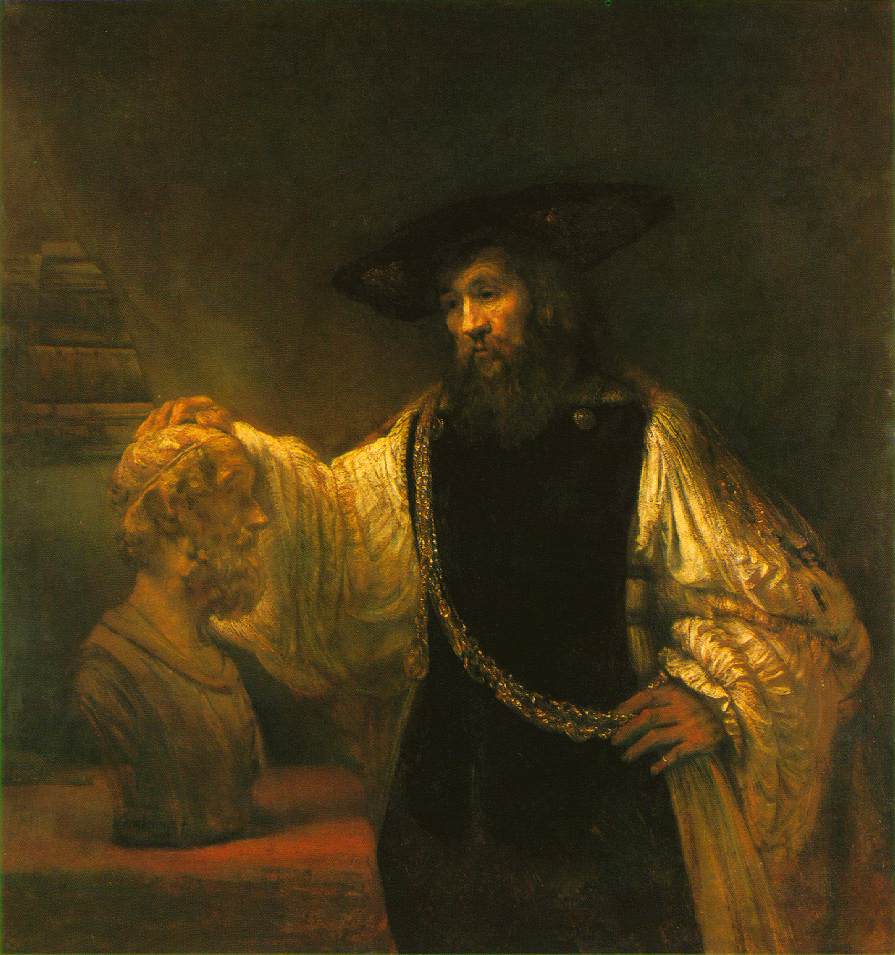
Rembrandt is my mystic, he pictures the human soul.
Dostoyevsky is my best friend, he understands me entirely.
With Wagner it is all drinks, and we drink it strong!
Tolstoy is my master, he teaches me to stare and hear.
Whereas with Victor Hugo it's just fighting,
sometimes with arguments, sometimes with fists.
Marx is a teacher I admire and hear, but only sometimes.
Beethoven, he is my best friend, my councilor, my redeemer!
Hegel became my intellectual guide, casting shadows away,
but more shadows took their place.
Rachmaninoff is my confessor, he knows my darkest secrets.
David shows me glory, that which I will never see.
Tchaikovsky, with him it is all drinks,
sometimes vodka! and sometimes tea.
Kant convinced me for a while, now I admire him as opponent.
Voltaire is my enemy, Rousseau is hard to find.
Machiavelli is my best friend, with whom I share the same passion:
our love and admiration for distant past.
Goya is like my mirror, he tells me how I am.
Nietzsche showed me the truth,
now I don't know how to do without it.
And Hanna Arendt?
Well gentlemen, she's unavailable,
because she is my girlfriend!
martes, 1 de marzo de 2011
Why Liberals don't understand
First of all I would like to explain from where my inspiration in republicanism comes from. I think this is something shared between intellectuals and academics in this tradition, but it is a feature that seems to be left aside. Republicans are deeply influenced by the Roman experience. Rome is a symbol of the highest degree in our thought and ideas (even more than Sparta and Athens, Venice or Florence). However I've realized that common-sense thought has a completely different understanding by the symbol Rome, and from here springs the most radical of contradictions.
It took me some time to realize this, but when I speak Rome, I've noticed that almost everyone thinks and remembers the experience of the Roman Empire, the period of the Caesars, the longest tyranny known so far. The great abyss between me and most liberal interlocutors starts here. When I speak Rome, it seems self-evident to me that I'm referring to the Roman Republic, its institutions, its laws, its traditions, its multiple inter-generational heroes and their political virtues and prudence. The Rome of the Scipios, of Fabio Maximus and Marcellus, Titus Flaminius, Aemilio Paulus, Cato the Older and even up to the decadent times of Cicero and Cato the Younger, Brutus and Cassius. The Rome that defeated Pirrus and Carthage, and that put the Macedonian dynasties to their knees. This Rome is so different, and contrasts so much with the Rome enslaved by Octavius, that the sole names Imperator and Caesar should strike republicans with obnoxious feelings. This is the first thing that people must understand when we speak the name of Rome, and not the nefarious names of Caligula and Nero. Not only is it Caesarism reason of repugnance in itself as a tyranny, as Tacitus well portrays, but also for the reason it was Caesarism that violently killed the republican dream, as we read in Sallust.
Another name that strikes liberals in a totally alienated way is that of Machiavelli. The Florentine writer is probably one of the most influential and venerated thinkers in Western republican tradition. Most people would be surprised by this, and it is because most people associate Machiavelli with The Prince, the most insightful treaty on tyrannical rule. They forget that more than The Prince, it is in The Discourses that we read the sincere and honest Machiavelli. A treatise based on comments on Titus Livy's History of Rome, The Discourses are a profound explanation of the classical republican creed previous to liberal ideas, and its respective abhorrence toward tyranny (In The History of Florence there is also a wealthy account of Machiavelli's republicanism as opposed to tyranny). People, in a curious parallel of thinking in Rome as the Empire instead of as the Republic, hear and think of Machiavelli as The Prince, instead of as The Discourses. Of course popular culture is partly to blame. The Prince is so much more famous, just as Ceasars are so much more portrayed in movies and literature than the ancient patriots. No wonder why people get so surprised when you tell them that your examples and highest symbols are Rome and Machiavelli, names that common-sense remembers with dread instead of admiration. This memory of only part of the story (the ugly part), plays a role in what makes the republican tradition so alien in our liberal-dominated times.
These misconceptions, errors in communication, make liberal and republican tradition seem so exclusive, whereas in sooth it's not the case. Common ground between both is not scarce, especially because liberalism first emerged as a branch of classical republicanism. But today's liberal confusion of portraying republicanism as an authoritarian ideology kindred in spirit to fascism is nothing but a blatant calumny, demonstrating nothing but short-sightedness and ignorance. However it is true that republicanism in its classical form is a-liberal, which is not the same as to say anty-liberal! A-liberal in the sense that its political values are previous to liberalism, and somehow lack many of its features, and for good reasons. While liberals are so concerned about the danger of coercing the individual, republicans are deeply disturbed by the potentiality of the tyrant, historically embodied by Julius Caesar. Liberals don't care much about who's in power and how, as long as he behaves and respects individual rights; republicans can't understand this respect for citizens without addressing the structure of political institutions in relation to citizenship itself.
Probably the most contrasting difference between liberals and republicans is that they focus, give priority and value different things. Tyranny, that is, uni-personal arbitrary and illegitimate rule is the most obnoxious possibility for republican tradition; considered the ultimate state of political slavery. Whereas for liberals individual rights and entitlements are universal, and any violation of what they interpret as these rights is illegitimate (Even the tyrant has rights). For republican thought this might be nothing more than absolute naivete, because the most important value is patriotism, the love for your country, its institutions and its liberty. This could contradict what liberals consider individual universal rights, especially if it implies making war against another country, where the most human of rights, life, is systematically alienated. This might be true also for republicans, but from our perspective it's a price we have to pay in the service of our country. Individual rights are just simply not that relevant when the safety and liberty of your country is at stake (Lincoln proved it). This is a statement of facts that usually liberals are not willing to acknowledge. Differences of this short are those that would permit, for example, discrepancy regarding Israel. Whereas I as a republican admire the strength and courage of Israel's republic, a liberal would focus on its terrible human rights record. It's not that I deny this record to be condemnable, which it is; it's just that I don't consider it politically relevant. The same happens when liberals are willing to negotiate with a mild dictator (as it happens so often when they use the fetish concept self-determination), whereas republican thought finds them obnoxious and worthy of intervention and replacement (let us say, a nefarious tyrant like Saddam Hussein, or today's Gaddafi!).
In conclusion, something that liberals are inclined to do: they confuse patriotism with nationalism, which would make republicanism side by side with a regime of a man like Mussolini, for example. Under republican standards, any regime like those of Bonaparte, Mussolini, Hitler, Franco, Peron, Castro, Chavez, etc., stand in the hall of the Caesars; of Tiberius, Caligula, Neron, Commodus, etc. A liberal could like Marcus Aurelius (like J. S. Mill did), but a republican would always repudiate its regime as a matter of political principles. Republicanism demands republic, and it's logically irreconcilable with any style of tyrant. Hobbes is a correct example that liberals wouldn't necessarily pass this test.